Trillion did not start as Trillion. It started with a kid who wanted to design buildings, and it took a drop shot, a crêpe stand, a shirt brand, three communities and two years of software to get here. None of it was a straight line. Looking back, it was one question asked many ways: what is the one thing that moves this forward?
Jibran Akhtar, founder of Trillion. Put together from his journals, notes, texts, recordings and the history of his code.
Date pieced together from his notes
He wanted to be an architect
As a kid, Jibran wanted to design buildings that thousands of people would walk past every day for decades. In high school he drew an apartment building for downtown Birmingham, Alabama in AutoCAD and worked on every detail of it in his free time.
From: his notes on his own values, January 2024; a walk recording, September 28, 2026.
The drop shot he could not answer
At 12, seeded at a tournament in North Carolina, he lost 6-0, 6-0 to a boy who drop-shotted him all match. He went home and spent weeks practising nothing but the drop shot, until it was his. He still has it. Years later he saw this as the first time he did what Trillion now does: find the one weakness that decides the result, and fix that before anything else.
From: his written tennis journey; a walk recording, September 28, 2026.
A system that made him worse
His family put about $400,000 into his tennis over the years, much of it into an academy abroad. The one-size training there made his game worse, not better. He came home in 2015 unsure of his own swing, and with a question he kept coming back to: why do people get stuck?
From: his written tennis journey; his founder story script, September 2025.
Date pieced together from his notes
From buildings, to cities, to one person
A year or two before college he dropped architecture: the buildings he wanted to design would not come until he was 70. City planning pulled at him next, because it shapes how whole communities live. Then he decided governments move too slowly, and that a better society starts with one person changing what they do, which spreads to the people around them, then their community, then further.
From: a walk recording, September 28, 2026.
Date pieced together from his notes
Building a group that stays close
In his fraternity, Theta Chi, he became assistant marshal for the pledges. Instead of the usual hazing, he had them build things, cook and eat together, and ask each other real questions. That pledge class stayed close friends. It was not the first group he had started, either: he had set up a group chat that gathered hundreds of the best junior tennis players in the South.
From: his notes on his own values, January 2024; his 2023 journal; a walk recording, September 28, 2026.
He quit tennis
After about 15 years of training, most days of his life, he quit the college tennis team. Tennis had become routine, and he felt nothing about the game any more. He stayed away from it for about four years.
From: his written tennis journey.
A crêpe stand on campus
He had run a crêpe stand in Spain in high school. In his last year at UAB he bought a crêpe machine and started 811 Crepes, selling $5 crêpes Thursday to Saturday from 9:30 at night to 2 in the morning. Within weeks it was the talk of campus. It taught him he could start something people loved and run it in public.
From: his life-story notes, February 2024; his written tennis journey.
2,000 hours on an app before the first customer
Kewd Up was a nightlife app: plan a whole night out with friends in two minutes, pay the cover ahead and skip the line. He programmed it for about 2,000 hours. Around 250 people signed up at launch, but only two bars did. The lesson stayed with him: find the people who will pay before you build.
From: his life-story notes, February 2024; his 2023 journal.
Date pieced together from his notes
Back to tennis with a different question
He came back to tennis, this time not to win matches but to understand learning itself. He rebuilt his own swing and found he could turn a student's weakness into a strength in weeks. That became his coaching, and later Ethos School of Tennis.
From: his written tennis journey; his founder story script, September 2025.
"We should just make our own shirt brand"
In July 2023 Jibran and his friend Tyler Thomas were texting about NoBull training shirts, which Tyler had put him onto. In August Jibran wrote: we should just make our own shirt brand. They picked the name Ethos, and the idea became: become your 2.0 self.
From: his texts with Tyler Thomas, July and August 2023, read out on a walk recording; his 2023 journal.
Two dots over the O
By the end of August his journal already spelled it Ethös. Someone close to the brand read the two dots over the O as two people: you become your best self faster with others than alone. He kept that meaning, and it runs through everything since, all the way to Trillion's network of people.
From: his 2023 journal; a walk recording, September 28, 2026.
Date pieced together from his notes
Cotton, not plastic
Months with a cheap supplier that kept letting them down taught him how much polyester and other plastics end up in athletic clothes. Nobody was making good athletic shirts in plain cotton. Ethos turned toward natural fibres. Friends still wear those shirts.
From: a walk recording, September 28, 2026.
Date pieced together from his notes
Pickleball, campuses, then all in on coaching
Everyone was starting run clubs, so he planned pickleball events instead: an easy first step for people who were not moving much. Then college campuses, with student ambassadors, the way Facebook and Snapchat started with students. Then he stopped. He could not do everything, so he put the brand down and went all in on teaching tennis, full time by that summer.
From: a walk recording, September 28, 2026; his written tennis journey.
Tribes
Watching Marc Lou build software live on YouTube, he wanted one place to find everyone building in public. That grew into Tribes: a community where every member is put in a small group, the groups double from 2 to 4 to 8 to 16 to 32, and each person helps the one just behind them. By June 2024 he was recording its sign-in screen.
From: his Tribes screen recording, June 16, 2024; his Tribes notes; a walk recording, September 28, 2026.
Date pieced together from his notes
An ad for the club he was about to build
Then an ad appeared for Founders Sports Club: sports meetups for founders who want to become their best selves. It was almost exactly what he had been designing. He signed up, and joined the founder community behind it, Art of Mondays. Early on he was one of its most active members, posting, meeting people and making introductions.
From: a walk recording, September 28, 2026; his post to the community, February 2025.
Why list every kind of thing in advance?
He wrote down a data model of entities, relationships and types. The question behind it: why should software decide ahead of time every kind of thing and every kind of link between things? He kept coming back to it.
From: his data model notes, May 20, 2025.
A matchmaking hub, built in days
In the community he kept thinking: they should be connecting us. So he built it himself in a couple of days: a hub that matched members with each other, with AI suggesting what to talk about. He showed it on July 13. Then he chose not to launch it as a one-off, because every app he wanted should be built from the same reusable parts.
From: his screenshots of the hub, July 11, 2025; his presentation screenshots, July 13, 2025; a walk recording, September 28, 2026.
Architect: build the parts once
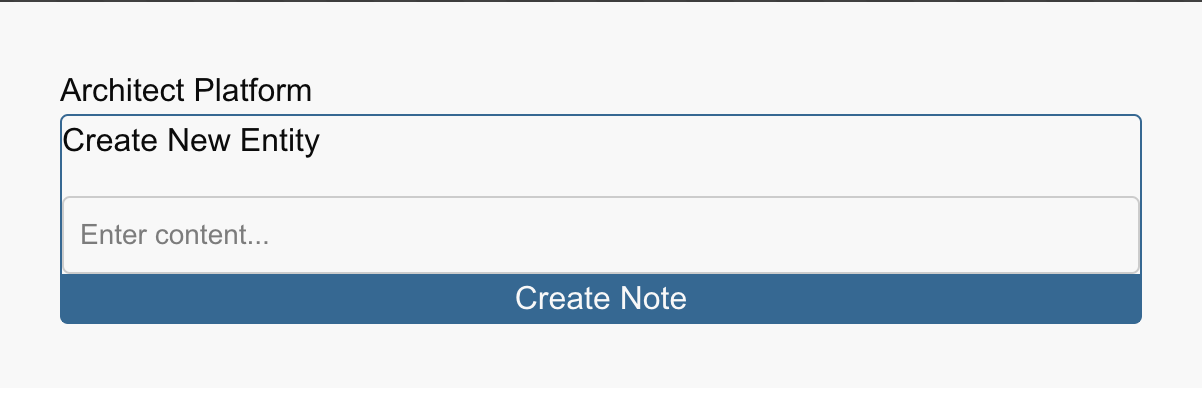
Architect's first screen, August 2, 2025.
So he started building the parts once: a screen engine, a workflow engine, a formula engine. He called it Architect, the kid who wanted to design buildings, now designing software that builds software. Its first screen could create one thing and show it.
From: his Architect screenshots, August 1 and 2, 2025; a walk recording, September 28, 2026.
One way to store anything
The entities-and-relationships idea became a single data model for every app, in Architect's first database tables on October 1. That same month he first put into words what felt off in the community he had joined: it was using community to grow a business, and nobody was actually helping members get where they were going.
From: the history of the Architect code, October 1, 2025; a walk recording, September 28, 2026.
New Year's Eve, and the meaning of life
One video, his own framework and several hours with an AI on New Year's Eve gave him an answer he still uses: use curiosity to find the truth, then make change based on that truth. The most meaningful life is to get obsessed, test the truth in the hardest places, and make bigger and bigger changes in line with it.
From: a walk recording, September 28, 2026; his messages to his AIs, September 2026.
Bitfield
Architect's parts were split into packages that could be installed, changed and combined, and the whole thing became Bitfield, with its own site by April 19. The idea: every piece of software is a part you can reuse, and no one should build the same thing twice.
From: the history of the Bitfield code, April 9 and 19, 2026.
A road trip to Yellowstone
On a road trip to Yellowstone with his dad, from late July to August 5, the pieces came together in his notes and recordings: the people and tools around you should take responsibility for your outcome. Not hand you an idea and leave you to it, but notice, act, and keep going with you until it is done.
From: a walk recording, September 28, 2026, describing his trip notes and recordings.
Trillion, in days
Then he questioned the one requirement he had never questioned: why does it all have to run on Bitfield? He set aside about two years of that work, kept its principles, and started Trillion. The first Trillion code went in on September 24. gettrillion.ai was up two days later.
From: the history of the Trillion code, September 24 and 26, 2026; a walk recording, September 28, 2026.
What he does, in one line
On a long walk he put the whole path into one line, from a note he wrote that morning: he helps people figure out what is worth pursuing, find the biggest needle mover, and act on it faster, in a way that serves the greater good of bettering human society. The kid who wanted to design cities had found where change starts.
From: a walk recording, September 28, 2026.
Where it points now
Every step above was the same move: find the one thing that matters most, and go all in on it. Trillion is that move made into a tool, so your AI can find the needle mover with you and then get it done.